Monday, April 25, 2011
Top Mistakes by Cat Owners

Adopting your first cat is a huge step, not to be taken lightly. Although cats have a reputation for taking care of themselves, that fact does not equal "no care is necessary." Before rushing in to buy that darling kitten in the pet store window (which is a mistake in itself), take the time to do your homework, so you can avoid these common mistakes made first by new cat owners. Forewarned, you will also be able to avoid mistakes made by experienced cat owners. The result will be a happier and healthier cat and a long-term companionship with another living being, the like of which you never dreamed.
 Adopting in Haste
If you "impulse-buy" a new purse or a new t-shirt, you can almost always return it if it turns out to be the wrong color or the fit isn't right. No harm, no foul; the purse certainly doesn't suffer from its rejection. But adopting a living, sentient creature such as a cat and kitten, to become a family member, is entirely a different matter.
Ignorance of the Costs of Responsible Cat Care
Adopting a cat can almost be compared with adopting a child. No responsible adoption agency would release a precious child to someone who was not financially prepared to give him or her the best possible care.
While some shelters and cat adoption groups make no such investigation, you owe it to your cat to take care of his basic needs, as well as being prepared for emergencies.
Failure to Spay or Neuter a New Cat
Every day I read pleas for help from people who failed to spay or neuter their cats: male cats spraying every available surface of the house or escaping outdoors to fight other male cats; female cats who keep the household awake with their loud yowling during estrus; and worse yet, "surprise" litters of unwanted kittens. The overwhelming cat population problem society faces is reason alone to spay and neuter. Add the medical problems averted by S/N and there is no reason not to do so.
Neglecting Needed Veterinary Treatment
Although cats may quickly recover from minor illnesses, they can just as quickly die if an emergency isn't recognized. Cats need certain vaccinations, they need annual examinations, and they definitely need and deserve immediate veterinary care when they become sick or injured.
Don't delay in choosing (and using) a good veterinarian.
False Economy in Cat Food Choices
Money saved by buying cheap cat food will be spent hundreds of times over on veterinary care. Cats are obligate carnivores, and need a good source of meat protein. They do not need large amounts of grain fillers, especially corn, which is a cheap source of protein used by many cat food manufacturers. Learn how to choose cat food and select the best brands you can afford. You'll find your cat may eat less of the high quality food because they don't have to gorge to get the nutrients they need.

Declawing Without All the Facts
Many an innocent new cat owner has been led down the declaw path when a veterinarian asks, "Do you want your kitten declawed when we spay her?" Some veterinarians consider declawing a "routine" surgery, while cat advocates consider it cruel, inhumane, and unnecessary in almost every case. Learn the facts so that you can make an informed decision.
Allowing a Cat to Roam Free Outdoors
Many people believe cats deserve the freedom, fresh air, and sunshine of an outdoor life, while many others can offer proof that cats can be very happy and healthy living totally indoors. That the outdoors offers dangers not found inside simply cannot be debated. Fortunately, there are a number of compromises that will give you and your cat the best of both worlds, while keeping him safe and happy.
Neglecting Litter Box Maintenance
Cats will consistently use a litter box, if it is kept scrupulously clean, and if the litter is not scented or unpleasant to the cats' feet. Carefully maintaining your cat's litter box will almost guarantee you that you will not be faced with litter box avoidance problems.
Caveat: If your cat suddenly starts urinating outside the box despite your careful maintenance, you should immediately suspect a urinary tract problem, which is a veterinary emergency.
Considering a Cat Property
When you join the ranks of cat lovers, you'll soon find that we commonly refer to our cats as family members, rather than "pets." While cats may legally be considered "property" in some jurisdictions, the term ends there. You can no more "own" a cat than you can own another human being. If you haven't figured out the distinction by now, your new cat will let you know in quick order. In fact, many cat lovers describe themselves as being owned by their cats!
Not Allowing a Cat to Be a Cat
A cat is not a child, and a cat is not a dog. Cats' unique ways make them the endearing creatures they are. On the other hand, some of their traits may cause frustration because we don't understand their needs. Cats instinctively seek out high places and sharpen their claws because they are cats, not because they are stubborn and disobedient. Our job is to accommodate those needs in acceptable ways.
6:10 AM 0
Tuesday, December 14, 2010
Cats - Domesticated varieties

The concept of a cat breed appeared in Britain during the late 19th century. The current list of cat breeds is quite large: with the Cat Fanciers' Association recognizing 41 breeds, of which 16 are "natural breeds" that probably emerged before humans began breeding pedigree cats, while the others were developed over the latter half of the 20th century. The owners and breeders of show cats compete to see whose animal bears the closest resemblance to the "ideal" definition and standard of the breed (see selective breeding). Because of common crossbreeding in populated areas, many cats are simply identified as belonging to the homogeneous breeds of domestic longhair and domestic shorthair, depending on their type of fur. In the United Kingdom and Australasia, non-purebred cats are referred in slang as moggies (derived from "Maggie", short for Margaret, reputed to have been a common name for cows and calves in 18th century England and latter applied to housecats during the Victorian era). In the United States, a non-purebred cat is sometimes referred to in slang as a barn or alley cat, even if it is not a stray.
Cats come in a variety of colors and patterns. These are physical properties and should not be confused with a breed of cat. Furthermore, cats may show the color and/or pattern particular to a certain breed without actually being of that breed. For example, cats may have seal point coloration, but not be Siamese.
Some original cat breeds that have a distinct phenotype that is the main type occurring naturally as the dominant domesticated cat type in their region of origin are sometimes considered as subspecies and also have received names as such in nomenclature, although this is not supported by feline biologists. Some of these cat breeds are:
- F. catus anura – the Manx – The Manx is a stocky, solid cat with a dense double coat (long or short), a compact body, very short back, hind legs that are visibly longer than the front legs, big bones, a wide chest, and greater depth of flank (sides of the cat nearest the rear) than other cats. A female Manx would not weigh more than 10 pounds and a male does not weigh over 12 pounds. Specific to this breed is the way their ears appear as a "cradle" when looked at from behind. A Manx cat is mainly recognized by its appearance as it does not have a tail. Although some of them may have a small tail, most Manx cats are tailless. Because of the genetic deformation of these cats they are susceptible of developing what is called Manx Syndrome, a condition that could be fatal for a kitten. Although the gene normally affects only the tail, there is the risk of causing damage to the spine such as fused vertebrae.
- F. catus siamensis – the Siamese – Siamese cats are amongst the firstly recognized Oriental cats, a type of cat with a long body but an elegant posture. The length is the main characteristic based on which these cats are distinguished. Their body, legs and tail are all long and still Siamese cats are known for their grace. Also, they are famous because of their blue almond eyes and they are also called "people cats" because of the affection they show to their owners.
- F. catus cartusenensis – the Chartreux – The Chartreux is a natural French breed, which is easily recognized by its size, grayish color and double coat. These cats are also famous because of the paradox coming from the combination between a massively build body and smiling expression and sweet voice.
- F. catus angorensis – the Turkish Angora
9:35 PM 0
Cat Diseases
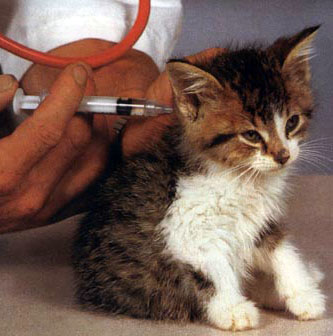
Infectious disease
An infectious disease is caused by the presence of organisms such as viruses, bacteria, fungi, or parasites (either animalian or protozoan). Most of these diseases can spread from cat to cat via airborne pathogens or through direct or indirect contact. Certain infectious diseases are a concern from a public health standpoint because they are zoonoses (transmittable to humans).
Viral
Viral respiratory diseases in cats can be serious, especially in catteries and kennels. Causing one-half of the respiratory diseases in cats. Timely vaccination can reduce the risk and severity of an infection. Feline viral rhinotracheitis is the most important of these diseases and is found worldwide. The other important cause of feline respiratory disease is the feline calicivirus.
Feline viral rhinotracheitis (FVR) is an upper respiratory infection of cats caused by feline herpesvirus 1 (FHV-1), of the family Herpesviridae. It is also known as feline influenza. FVR is very contagious and can cause severe disease, including death from pneumonia in young kittens. All members of the Felidae family are susceptible to FVR,
Feline calicivirus (FCV)
Chlamydophila felis
Feline panleukopenia (FPV) more commonly known as feline distemper is caused by the feline parvovirus, a close relative of canine parvovirus. It is not related to canine distemper. Panleukopenia is primarily spread through contact with an infected cat's bodily fluids, feces, or fleas.
Feline leukemia virus (FeLV) is a retrovirus transmitted between infected cats when the transfer of saliva or nasal secretions is involved, for example when sharing a feeding dish. If not defeated by the animal’s immune system, the virus can be lethal. The disease is a virus, not a cancer. The name stems from the fact that the first disease associated with the virus was a form of leukemia. By the time it was discovered that the virus was not the same as leukemia, the misnomer had already found its way into the vocabulary of pet owners.
Feline immunodeficiency virus (FIV), commonly known as Feline AIDS is a lentivirus that affects domesticated house cats worldwide. FeLV and FIV are in the same biological family, and are sometimes mistaken for one another. However, the viruses differ in many ways. Although many of the diseases caused by FeLV and FIV are similar, the specific ways in which they are caused also differs.
Feline infectious peritonitis (FIP)' is a fatal, incurable disease caused by Feline Infectious Peritonitis Virus (FIPV), which is a mutation of Feline Enteric Coronavirus (FECV/FeCoV). The mutated virus has the ability to invade and grow in certain white blood cells, namely macrophages. The immune system's response causes an intense inflammatory reaction in the containing tissues. This disease is generally fatal. However its incidence rate is roughly 1 in 5000 for households with one or two cats.
Rabies in cats is a fatal disease transmitted by the bite of an infected mammal, such as a dog, raccoon, bat, or another cat. Animals with rabies suffer deterioration of the brain and tend to behave bizarrely and often aggressively, increasing the chances that they will bite another animal or a person and transmit the disease. Rabies is rare in many developed countries with more than 99% of all human deaths from rabies occurring in Africa, Asia and South America which report thirty thousand deaths annually. In the United States, cats make up 4.6% of reported cases of rabies infected animals.
H5N1. See: Global spread of H5N1#Felidae (cats)
Vaccination
Main article: Feline vaccination
Fungal
Ringworm
Parasites
Cytauxzoonosis is a mostly fatal tick-borne disease in domestic cats. It is identified as the blood parasite Cytauxzoon felis.
Ear mites are mites that live in the ears of animals.
Flea
Heartworm
Roundworm
Tick
Toxoplasmosis
Genetic disease
A cat displaying heterochromia
Familial renal disease is inherited in Abyssinians and Persians
Feline hypertrophic cardiomyopathy
Heart valve dysplasia
Heterochromia
Luxating patella
Portosystemic shunt. Found in Persians and Himalayans.
Skin disorder
Further information: Cat skin disorders
Cat skin disorders are among the most common health problems in cats. Skin disorders in cats have many causes, and many of the common skin disorders that afflict people have a counterpart in cats. The condition of a cat's skin and coat can also be an important indicator of its general health. Skin disorders of cats vary from acute, self-limiting problems to chronic or long-lasting problems requiring life-time treatment.
Cheyletiella is a mild dermatitis caused by mites of the genus Cheyletiella. It is also known as walking dandruff due to skin scales being carried by the mites. Cheyletiella live on the skin surface of dogs, cats, rabbits, and humans.
Feline acne
Feline eosinophilic granuloma
Flea allergy dermatitis
Hyperthyroidism
Miliary dermatitis (feline eczema)
Mange
Tumors and cancer
Bladder cancer
Bone cancer
Intestinal cancer
Liver cancer
Lymphoma in animals
Mammary tumor
Mast cell tumor
Nose cancer
Skin cancer
Soft tissue sarcoma
Stomach cancer
Other diseases
Cerebellar hypoplasia is a disorder found in cats and dogs in which the cerebellum is not completely mature at birth. Cerebellar hypoplasia causes jerky movements, tremors and generally uncoordinated motion. The animal often falls down and has trouble walking. Tremors increase when the animal is excited and subside when at ease.
A corneal ulcer is an inflammatory condition of the cornea involving loss of its outer layer. It is very common in dogs and is sometimes seen in cats.
Diabetes
Epilepsy is characterized by recurrent unprovoked seizures. Epilepsy in cats is rare likely because there is no hereditary component to epilepsy in cats.
Feline asthma
Feline Hepatic Lipidosis also known as Feline Fatty Liver Syndrome, is one of the most common forms of liver disease of cats. The disease begins when the cat stops eating from a loss of appetite, forcing the liver to convert body fat into usable energy.
Feline lower urinary tract disease is a term that is used to cover many problems of the feline urinary tract, including stones and cystitis. The term feline urologic syndrome is an older term which is still sometimes used for this condition. It is a common disease in adult cats, though it can strike in young cats too. It may present as any of a variety of urinary tract problems, and can lead to a complete blockage of the urinary system, which if left untreated is fatal.
Feline odontoclastic resorptive lesion
Feline spongiform encephalopathy
Polyneuropathy
Pyometra
Uterine unicornis a condition in which the female cat is missing a uterine horn. A rare discovery by veterinarians, the condition can be detected by x-ray or ultrasound prior to spaying if the patient has a family history of the medical condition. There is no known scientific study to prove that uterine unicornis is a hereditary genetic disorder. In some cases, the patient may also be missing a kidney on the same side as its missing uterine horn. This phenomenon is also called unilateral renal agenesis.
Detection and disease prevalence
Feline diseases such as FeLV, FIV, and feline heartworm can be detected during a routine visit to a veterinarian. A variety of tests exist that can detect feline illnesses, and with early detection most diseases can be managed effectively.
Zoonosis
Researchers at the University of Cornell Feline Health Center believe that "most zoonotic diseases pose minimal threat" to humans. However some humans are particularly at risk. These are people "with immature or weakened immune systems" (infants, the elderly, people undergoing cancer therapy, and individuals with acquired immunodeficiency syndrome).
Some common and preventable forms of zoonosis are as follows:
Toxoplasmosis
Giardia
Cat-scratch disease
Rabies
Ringworm
6:05 AM 0
Keep your cat safe in cold weather
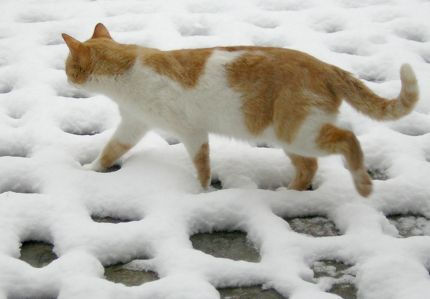
Winter has arrived in Central New York, and it has settled in for the long haul. It is important to take special care of pets of all species, and there are some specific steps we can take to make sure our pet cats - as well as stray and feral cats - stay safe during these cold months.
Keep your cat(s) inside. Some people think this is cruel to keep cats indoors, but the threats from vehicles, disease, other animals and twisted humans are far worse. As long as you keep up with cleaning and make sure your cat has plenty of toys and attention, she will live a fulfilling feline life.
Cats that are outdoors - be they stray, feral or owned - will seek warm shelter in this weather. Too often, that shelter is under the hood of a vehicle. Many an unsuspecting driver has turned their ignition and seriously injured a cat that has sought comfort. Before starting your vehicle, knock on the hood a couple of times to rouse any animal that might have sought shelter there and give it a chance to escape.
Beware of salt an other ice melting substances and antifreeze. Clean up spills immediately and thoroughly, and clean off your shoes well. These substances are toxic to our feline friends and can, at best, cause illness and, at worst, cause death.
If you look after feral or very skittish stray cats, you can build or purchase winter shelters for them. As the weather gets warmer, keep Spring Farm CARES feral trap/neuter/vaccinate/return program in mind.
Pets left in cars get the most attention during the warmer months, but remember that vehicles quickly become frigid in these temperatures so never leave cats - or any other pet - unattended in a motor vehicle.
When celebrating the winter holidays, be sure that kitty does not get in trouble with candles, plants or the Christmas tree. Also, be wary of giving your cat treats of "people food." Foods such as chocolate and alcohol can be dangerous, while milk and garlic can cause great discomfort.
With our cats, the adage "an ounce of prevention is worth a pound of cure" certainly rings true. Common sense and attention to details will help you keep your cat happy and healthy year round.
1:20 AM 0
Subscribe to:
Posts (Atom)

